




INTRODUCTION
01 Pursue God
- Preview this sermon with the video, podcast, and article below.
- Access this sermon’s slide template on Canva and customize as needed.
- Preach this sermon and direct families, small groups, and mentors to pursuegod.org/go.
- Click on the gray toggles for additional sermons in this series.
Why Pursue God?
We pursue God because he is for us, not against us. Jesus offers a full life that touches everything from our relationships to our eternity, and God has been pursuing us since before we were born. The Bible promises that anyone who genuinely seeks God will find him. Wherever you are on your spiritual journey today, God is not far away.
Where Are You on the Journey?
Take a quick personal survey as we start this series: do you feel close to God or far from him? Many people picture God as harsh, judgmental, or distant. But the Bible paints a very different picture. Here are three things you need to know about the heart of God, and the good news it reveals about pursuing him.
God Is for You
Everyone knows what rejection feels like. Maybe you’ve been rejected by a friend, a spouse, or even a parent. Some people feel that way about God. They feel unworthy, unlovable, or just plain irreligious, and God seems out of reach.
But Jesus shows us the truth: God is for you. Jesus shocked the religious world by inviting fishermen and despised tax collectors into his inner circle. He ate with outsiders, healed the sick, and touched the untouchable. Here’s a perfect example.
Matthew 8:2-3 A man with leprosy came and knelt before him and said, “Lord, if you are willing, you can make me clean.” Jesus reached out his hand and touched the man. “I am willing,” he said. “Be clean!” Immediately he was cleansed of his leprosy.
The man knew Jesus had the ability to heal him. He just didn’t know if Jesus was willing. For most people, it’s easier to believe God is powerful than to believe he is good. But he is both. He’s good enough to care about your everyday life and powerful enough to do something about it.
Notice how Jesus healed the man: he touched him. That was unthinkable in Jesus’ day, because leprosy was contagious. Jesus could have simply spoken a word, but he wanted to make a point. God cares personally about people, and he isn’t afraid of their condition. Jesus extends this invitation to anyone who recognizes their need for him.
Mark 2:17 On hearing this, Jesus said to them, “It is not the healthy who need a doctor, but the sick. I have not come to call the righteous, but sinners.”
Here’s the great irony of religion: people who look the most religious are often the furthest from God, because they don’t think they need a Savior. What about you? Do you need God’s help? He’s willing to give it.
God Offers Life to the Full
God’s heart for you puts a whole new kind of life on offer. Jesus called it life to the full. It shapes your friendships, emotions, work, and connection with God, and it impacts both your everyday life and your eternal destiny.
John 10:10 The thief comes only to steal and kill and destroy; I have come that they may have life, and have it to the full.
We have a simple picture for this full life. We call it going “full circle” in your faith.
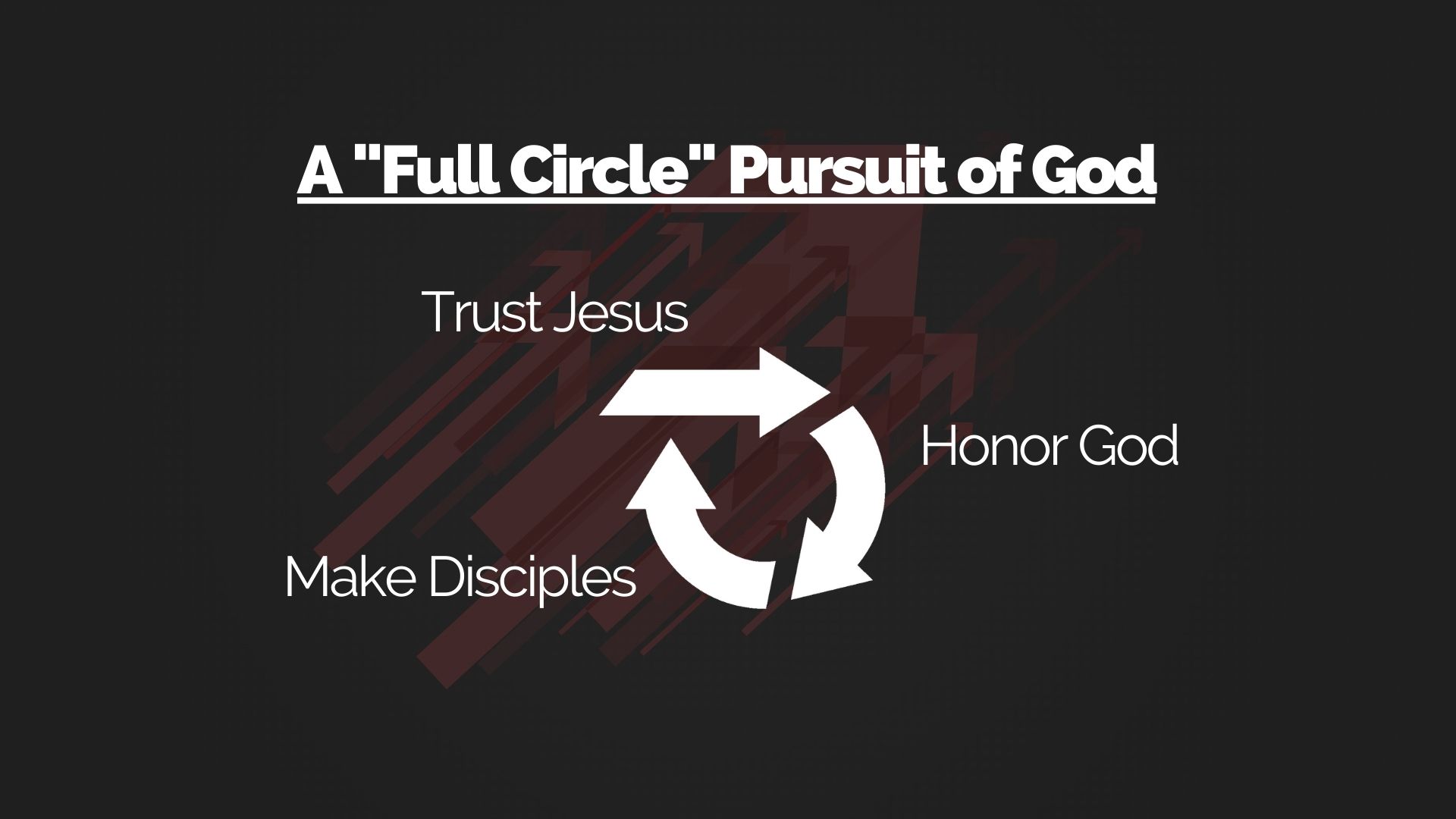
- Trust Jesus. We start a relationship with God by trusting Jesus (Romans 3:22). Faith changes our standing with God in an instant. We’ll cover this in Lessons 4–6.
- Honor God. After we come to faith, God gives us a new desire to honor him, and we’re transformed from the inside out over time (2 Corinthians 5:17). We’ll cover this in Lessons 7–9.
- Make disciples. Life to the full isn’t complete until we help someone else pursue God (Matthew 28:19). We’ll cover this in Lessons 10–12.
God Has Been Pursuing You
Pursuing God isn’t just up to you. Before you ever thought about pursuing God, he was pursuing you. King David learned this through a life full of battles, fame, and tragedy, and he wrote about it in one of his psalms.
Psalm 139:16 Your eyes saw my unformed body; all the days ordained for me were written in your book before one of them came to be.
The same is true for your story, even if you can’t see it yet. Your existence was God’s idea. Some people imagine God is playing a cruel game of hide-and-seek. The Bible is big, churches can be intimidating, and God seems complicated. But God makes a simple promise.
Jeremiah 29:13 You will seek me and find me when you seek me with all your heart.
God wants to be found by you, and he has been working since the beginning of time to make it happen. He made the first move. The next move is up to you. For now, just be genuine. Set aside your assumptions, come with an open mind, and open the Bible, because that’s where we learn about Jesus. That’s where we’ll go next in Lesson 2.
The Takeaway
We pursue God because he is for us, he offers life to the full through Jesus, and he has been pursuing us all along. God promises that everyone who seeks him wholeheartedly will find him. Wherever you are today, take the next step in your pursuit of God.

02 Why the Bible?
- Preview this sermon with the video, podcast, and article below.
- Access this sermon’s slide template on Canva and customize as needed.
- Preach this sermon and direct families, small groups, and mentors to pursuegod.org/go.
- Click on the gray toggles for additional sermons in this series.
Is the Bible Reliable?
Yes, the Bible is reliable. It has more manuscript evidence than any other ancient book, and discoveries like the Dead Sea Scrolls show it has been faithfully preserved. It tells one unified story centered on Jesus, even though it was written by about 40 authors over 1,500 years. And the changed lives of Jesus’ first followers point to the truth of its message.
Why the Bible Matters
In Lesson 1, we saw that God wants to be found. Before we can pursue the God of the Bible, though, we need to ask whether we can trust the Bible itself. It’s the best-selling book of all time. It has changed individual lives and shaped entire cultures, and it claims to be inspired by God. Here are three reasons we can trust it.
Historical Evidence
The Bible was written thousands of years ago, long before printing presses. Ancient copies were painstakingly written by hand, and many didn’t survive. Historians judge the reliability of ancient writings partly by how many copies exist. Here’s how the New Testament compares:
- We have only 49 copies of Aristotle’s writings.
- Homer’s Iliad does a little better, with about 643 copies.
- The New Testament has almost 5,700 Greek copies and more than 19,000 copies in other languages.
But how do we know those copies are faithful to the originals? The Dead Sea Scrolls help answer that question. In 1947, a shepherd boy discovered ancient scrolls hidden in caves near the Dead Sea. Eventually almost 1,000 manuscripts were recovered, including parts of almost every Old Testament book. Some were about 1,000 years older than any manuscripts known at the time. When scholars compared the Dead Sea Scrolls copy of Isaiah with the oldest copy previously known, they were about 95 percent identical, and most differences were minor spelling variations.
Textual Evidence
The Bible contains 66 books written by about 40 authors over 1,500 years. Moses, raised in Pharaoh’s palace, wrote the first five books. Others were written by shepherds, kings, prophets, a tax collector, a doctor, and a former persecutor of Christians named Paul. Most of them never met, and they wrote in different cultures and languages. Yet the Bible reads as one story, and fulfilled prophecy holds it together:
- Of Israel’s 12 tribes, Judah was predicted to be the one the Messiah would come from, and that’s exactly what happened (Genesis 49:10; Matthew 1:1-3).
- The Messiah was prophesied to be born in Bethlehem, even though his mother didn’t live there (Micah 5:2; Luke 2:1-4).
- Prophets described Jesus’ suffering and death hundreds of years before it happened (Psalm 22; Isaiah 53).
That’s why Jesus told the religious leaders of his day that the Scriptures were all about him.
John 5:39-40 You study the Scriptures diligently because you think that in them you have eternal life. These are the very Scriptures that testify about me, yet you refuse to come to me to have life.
Personal Evidence
The Bible is ultimately about Jesus, and the changed lives of his followers are some of the most compelling evidence for its message. Peter denied Jesus three times on the night of his arrest (Luke 22:56-60). Days later, the risen Jesus restored him (John 21:15-19), and Peter became a pillar of the church. Thomas doubted the resurrection until he met Jesus for himself (John 20:25-28). Paul was a Pharisee who persecuted Christians until he met Jesus and became the church’s greatest missionary. Each of these men eventually gave his life for his faith. It’s hard to explain such radical change unless they truly met the risen Jesus.
Still, no amount of evidence can overcome an unwilling heart. Jesus made this point as he taught in the temple courts.
John 7:16-17 Jesus answered, “My teaching is not my own. It comes from the one who sent me. Anyone who chooses to do the will of God will find out whether my teaching comes from God or whether I speak on my own.”
If you’re willing to come to God on his terms, Jesus promises you’ll discover the truth. The Bible is God’s Word, and we can trust it in our pursuit of him.
2 Timothy 3:16-17 All Scripture is God-breathed and is useful for teaching, rebuking, correcting and training in righteousness, so that the servant of God may be thoroughly equipped for every good work.
The Takeaway
The Bible is reliable. Manuscript evidence and archaeology show it has been faithfully preserved, fulfilled prophecy shows it tells one story centered on Jesus, and the changed lives of his followers show its message is true. If you’re willing to do God’s will, you can approach the Bible with confidence.
03 Imago Dei
- Preview this sermon with the video, podcast, and article below.
- Access this sermon’s slide template on Canva and customize as needed.
- Preach this sermon and direct families, small groups, and mentors to pursuegod.org/go.
- Click on the gray toggles for additional sermons in this series.
What Does the Bible Say about Imago Dei?
Imago Dei is Latin for “image of God.” The Bible teaches that every human being is created in God’s image, which gives every person inherent value and dignity. This truth is the foundation for the freedoms many of us take for granted, like life and liberty. It also reveals our purpose: because God is love and we are made in his image, we were made to love God and others.
Very Good
Every culture has a value system shaped by core beliefs, and Western civilization has been deeply shaped by the Bible. One of its most important ideas comes from the first chapter of Genesis. God created light and darkness, land and sea, plants, fish, birds, and animals, and he called it all good. Then, on the sixth day, he created human beings.
Genesis 1:27 So God created mankind in his own image, in the image of God he created them; male and female he created them.
After creating humanity, God updated his assessment of creation.
Genesis 1:31 God saw all that he had made, and it was very good. And there was evening, and there was morning—the sixth day.
What makes human beings “very good”? We are made in God’s image. That means we are like God in certain ways: mentally (we can think and create), relationally (we were designed for relationships), and spiritually (part of us lives forever). It also means we have a responsibility to represent God to the rest of creation. Every person has inherent value, and more than anything else in creation, people matter to God. To go deeper, read What Does It Mean to Be Created in God’s Image?
Life, Liberty, and Happiness
Imago Dei is also the basis for many freedoms we expect today. In 1776, America’s founders signed the Declaration of Independence, writing that “all men are created equal, that they are endowed by their Creator with certain unalienable Rights, that among these are Life, Liberty and the pursuit of Happiness.” They recognized that human rights come from God, not from a king or government.
Consider the right to life. God made it clear to Noah after the flood.
Genesis 9:6 Whoever sheds human blood, by humans shall their blood be shed; for in the image of God has God made mankind.
Human life is sacred because people are made in God’s image. That’s why we feel compassion and righteous anger when we hear about the murder of innocent people.
What about liberty? For most of human history, individual freedom was rare. Yet God modeled an open-handed kind of leadership from the very beginning.
Genesis 2:16-17 And the Lord God commanded the man, “You are free to eat from any tree in the garden; but you must not eat from the tree of the knowledge of good and evil, for when you eat from it you will certainly die.”
God gave Adam and Eve every good thing, and then he gave them the freedom to make their own choices, for better or for worse.
And then there’s the pursuit of happiness. Many people see God as a cosmic killjoy, but Christianity is filled with hope and joy.
Philippians 4:4 Rejoice in the Lord always. I will say it again: Rejoice!
Long before the Declaration of Independence, God invited all people to experience life, liberty, and joy, because he made all of us in his image.
A Purpose in Life
Imago Dei also helps answer a timeless question: what is the meaning of life? Because God is love (1 John 4:16), and we are made in his image, our purpose is to love. When religious leaders asked Jesus to name the greatest commandment, his answer caught them off guard.
Matthew 22:37-40 Jesus replied: “‘Love the Lord your God with all your heart and with all your soul and with all your mind.’ This is the first and greatest commandment. And the second is like it: ‘Love your neighbor as yourself.’ All the Law and the Prophets hang on these two commandments.”
Jesus didn’t name one of the Ten Commandments. He pointed to the heart behind all of them. People were made for relationships, not just rules. Being made in God’s image means you can have a real relationship with your Creator. That relationship transforms how you love others and even how you see yourself, because your value comes from who you are, not what you’ve done.
The Takeaway
Imago Dei means every person is made in the image of God. Sin has distorted that image, but it hasn’t erased our value. This truth is the foundation for life and liberty, and it reveals our purpose: to love God and others. Through Jesus, the perfect image of God, we can be restored and transformed.
#InvestigateChristianity
- Are Science and Faith Enemies?
- Does Science Require Faith?
- Is Faith Blind?
- What Should Christians Avoid Saying to an Atheist?
- Is the Human Body Evidence of a Creator?
- Can You Believe in God Without Having All the Answers?
- What Can the Beauty of Math Teach Us About God?
- Can Math and Logic Alone Lead You to Faith in God?
- Are People Basically Good?
- How Is Christianity Different From Other Religions?
- Has Christianity Done More Harm Than Good?
- What Does the Bible Mean by the Heart?
- What Happened on the Road to Emmaus?
- Where Did We Get the Bible?
- Is There Only One True Church?
- What Does God Really Think About Women?
- What Does the Bible Say about Salvation?
- What Does the Bible Say about Sin?
- What Does the Bible Say about Imago Dei?
- Is the Bible Reliable?
- Why Pursue God?
- Unboxing (Series)
- What Does Love Mean in the Bible?
- What Is a Biblical Worldview?
- What Can We Learn From Doubting Thomas?
- Why Does the Women’s Testimony Prove the Resurrection?
- Proof of Life (Series)
- Is There Really “No Evidence” for God’s Existence?
- Why Does God Let Bad Things Happen?
- Who Did Jesus Think He Was?
- The Dilemma of the Problem of Evil
- Don’t Just Follow Your Heart
- How Many Paths Are There to God?
- The Meaning of “Love” in Greek
- Relativism and the Rejection of Absolute Truth
TRUSTING JESUS
04 What Is Sin?
- Preview this sermon with the video, podcast, and article below.
- Access this sermon’s slide template on Canva and customize as needed.
- Preach this sermon and direct families, small groups, and mentors to pursuegod.org/go.
- Click on the gray toggles for additional sermons in this series.
What Does the Bible Say about Sin?
According to the Bible, sin is going your own way instead of God’s way, trusting your own opinions and feelings over God’s truth. It’s any action, thought, or attitude that falls short of God’s perfect standard. Sin breaks everything it touches, and every one of us is born with a sinful nature. That’s why Jesus said we must be born again.
Defining Sin
In Lesson 3, we learned that people are made in God’s image. So what went wrong? The story of Adam and Eve shows us. God placed them in the Garden of Eden and let them eat from every tree except one: the tree of the knowledge of good and evil. Then the serpent showed up and asked a question meant to plant doubt: “Did God really say…?” (Genesis 3:1).
Genesis 3:4-6 “You will not certainly die,” the serpent said to the woman. “For God knows that when you eat from it your eyes will be opened, and you will be like God, knowing good and evil.” When the woman saw that the fruit of the tree was good for food and pleasing to the eye, and also desirable for gaining wisdom, she took some and ate it. She also gave some to her husband, who was with her, and he ate it.
Notice how the serpent twisted God’s words to make him look stingy and controlling, then finished with an outright lie. Eve turned her back on the Creator and trusted the creature. Adam and Eve trusted their own opinions and feelings over God’s truth, and sin entered the world. The same basic story has repeated itself ever since.
Broken in Every Way
Sin isn’t just a theological problem. It’s a practical one. It keeps us from the full life God wants for us. That doesn’t mean we’re all as bad as we could possibly be, but the infection runs deep. Think of a glass of lemonade. One drop of poison contaminates the whole glass. Sin is like that poison. It affects our thinking, relationships, health, finances, and everything else.
Because of sin, we can’t keep the greatest commandments. Instead of loving God and others, we put ourselves first, and that causes brokenness spiritually, relationally, and emotionally. Paul gives a sampling of the fallout.
Galatians 5:19-21 The acts of the flesh are obvious: sexual immorality, impurity and debauchery; idolatry and witchcraft; hatred, discord, jealousy, fits of rage, selfish ambition, dissensions, factions and envy; drunkenness, orgies, and the like. I warn you, as I did before, that those who live like this will not inherit the kingdom of God.
Notice the range, from sexual immorality to simple envy. When it comes to sin, there’s something for everyone. And every generation seems to invent new ways to sin (Romans 1:30).
Born into Sin
When does this sin problem start? The Bible is clear that since Adam and Eve, every one of us has been born with a sinful nature.
Romans 3:10-12 As it is written: “There is no one righteous, not even one; there is no one who understands; there is no one who seeks God. All have turned away, they have together become worthless; there is no one who does good, not even one.”
Romans 3:23 For all have sinned and fall short of the glory of God.
Think about two-year-olds. They’re all born with a bent toward selfishness, and none of us fully grows out of it. That’s why Jesus said this.
John 3:3 Jesus replied, “Very truly I tell you, no one can see the kingdom of God unless they are born again.”
The solution to sin is to start over, to be born again to a new life in Christ. Jesus isn’t asking you to try harder or become a better person. He’s saying something has to happen to you that’s beyond your control. That’s how birth works. You don’t earn it. Someone else does all the work. We’ll see how Jesus did that work in Lesson 5.
The Takeaway
Sin is going our own way instead of God’s. It falls short of God’s perfect standard, breaks everything it touches, and affects every person from birth. We can’t fix it on our own, but through Jesus we can be born again and receive a brand-new life.
05 Who Is Jesus?
- Preview this sermon with the video, podcast, and article below.
- Access this sermon’s slide template on Canva and customize as needed.
- Preach this sermon and direct families, small groups, and mentors to pursuegod.org/go.
- Click on the gray toggles for additional sermons in this series.
What Does the Bible Say about Jesus?
The Bible teaches that Jesus is fully God and fully man. In Acts 10, the apostle Peter summarized the early church’s teaching about Jesus in five truths: he is Lord of all, he was perfectly good, he was crucified and rose again, he will judge everyone, and he forgives the sins of everyone who believes in him. That’s the good news at the heart of Christianity.
The Most Talked-About Person in History
Jesus is the most written about, fought over, and misunderstood person in history. In Lesson 4, we saw that sin is a problem we can’t fix ourselves. So who is Jesus, and how does he solve it? Peter’s sermon to a Roman centurion named Cornelius and his household was the first sermon preached specifically to non-Jews. It gives us five truths about Jesus.
1. Jesus Is Lord of All
Acts 10:36 You know the message God sent to the people of Israel, announcing the good news of peace through Jesus Christ, who is Lord of all.
Peter calls Jesus Lord, a reference to his divinity. Jesus is God the Son, the second person of the Trinity (John 1:1-4). Jesus claimed this himself (John 8:58), and his followers believed it.
Colossians 1:19-20 For God was pleased to have all his fullness dwell in him, and through him to reconcile to himself all things, whether things on earth or things in heaven, by making peace through his blood, shed on the cross.
Why does this matter? Jesus couldn’t give us peace with God if he were merely a good man. His divinity qualifies him to be our Savior. And notice that Jesus is Lord of all, not just of Israel. God sent Peter to a Gentile’s house to show that the gospel is for everyone.
2. Jesus Was Perfectly Good
Acts 10:38 How God anointed Jesus of Nazareth with the Holy Spirit and power, and how he went around doing good and healing all who were under the power of the devil, because God was with him.
Jesus cast out demons (Luke 4:40-41), healed people with leprosy (Luke 5:12-13), fed thousands (Matthew 14:13-21), walked on water (Matthew 14:22-33), and even raised a man from the dead (John 11:38-44). As we saw in Lesson 1, God is for you, and Jesus proved it.
Most important of all, Jesus never sinned. If he had been a sinner like us, he would have had to die for his own sins. Because he was sinless, he could go to the cross on our behalf.
3. Jesus Was Crucified and Rose Again
Acts 10:39-40 We are witnesses of everything he did in the country of the Jews and in Jerusalem. They killed him by hanging him on a cross, but God raised him from the dead on the third day and caused him to be seen.
From the outside, Jesus’ death looked like a tragedy, but it was God’s plan all along (Isaiah 53:8-10). And Jesus didn’t stay dead. He rose on the third day, proving his power over sin and death. This is central to the Christian faith.
1 Corinthians 15:14 And if Christ has not been raised, our preaching is useless and so is your faith.
How do we know the resurrection isn’t a myth? The simplest evidence is the response of Jesus’ closest followers. They abandoned him in fear before the crucifixion, yet they boldly proclaimed his resurrection afterward, and almost all of them died for that message.
4. Jesus Will Judge Everyone
Acts 10:42 He commanded us to preach to the people and to testify that he is the one whom God appointed as judge of the living and the dead.
Up to this point, it’s all good news. But Peter adds a sober warning. One day Jesus will judge every person, and on our own we can’t pass that test. God is loving, but he is also just. At the cross, God didn’t ignore our sin. He poured out his judgment on his Son. That’s where God’s justice and love meet.
5. Jesus Forgives Sins
Acts 10:43 All the prophets testify about him that everyone who believes in him receives forgiveness of sins through his name.
Thankfully, Peter didn’t end with judgment. The good news is that we can be forgiven, not through good works but through faith in Jesus. This is the new birth Jesus offers to sinners, and it’s available to everyone who believes. We’ll see how to receive it in Lesson 6.
The Takeaway
Jesus is Lord of all, perfectly good, crucified and risen, the judge of everyone, and the one who forgives sins. He is fully God and fully man, and he came to bridge the gap between us and God. Knowing who Jesus is means trusting him as your Savior and following him as your Lord.
06 Saving Faith
- Preview this sermon with the video, podcast, and article below.
- Access this sermon’s slide template on Canva and customize as needed.
- Preach this sermon and direct families, small groups, and mentors to pursuegod.org/go.
- Click on the gray toggles for additional sermons in this series.
What Does the Bible Say about Salvation?
The Bible teaches that salvation is a free gift from God, received by grace through faith in Jesus. God sent Jesus out of love. When we turn from our sin, believe that Jesus died and rose again, and declare that he is Lord, we are forgiven and given new life. We can’t earn it, and it’s available to everyone who believes.
What Is Saving Faith?
So far in this series, we’ve looked at humanity’s problem, sin, and God’s solution, Jesus. But knowing that Jesus died and rose again doesn’t save you by itself. Your personal response to Jesus is what opens the door to salvation. The Bible calls it saving faith, and here are five things you need to know about it.
It Starts with God’s Love
Why did God send Jesus to the cross? John gives the answer.
1 John 4:9 This is how God showed his love among us: He sent his one and only Son into the world that we might live through him.
Many religions picture a god who is full of wrath or who demands strict obedience in exchange for blessing. But the God of the Bible is relational. He reached out to us even though we had nothing good to offer, and he sent Jesus willingly, out of love.
It Requires a Change of Heart
Saving faith requires more than the right information about Jesus. It also requires the right attitude toward God, which the Bible calls repentance. When Peter preached the first sermon after Jesus’ resurrection, his listeners responded like this.
Acts 2:37 When the people heard this, they were cut to the heart and said to Peter and the other apostles, “Brothers, what shall we do?”
Peter had just told them that they rejected and crucified Jesus (Acts 2:14-36). Instead of getting offended, they were cut to the heart and humbly asked what to do. Peter’s answer was simple.
Acts 2:38 Peter replied, “Repent and be baptized, every one of you, in the name of Jesus Christ for the forgiveness of your sins. And you will receive the gift of the Holy Spirit.”
Repentance says, “I’ve changed my mind, and I’m ready to go God’s way now.” It’s a decision to stop running your own life and turn to God.
It Is Expressed in Words
When God begins a saving work in your heart, it’s important to express it. The Bible calls this confession, which literally means agreeing with what God has already said.
Romans 10:9 If you declare with your mouth, “Jesus is Lord,” and believe in your heart that God raised him from the dead, you will be saved.
Believe and declare. That’s how we respond to Jesus in faith. If you’re ready, you can pray a simple prayer like this:
“Jesus, I know I’m a sinner. I believe you died on the cross and rose from the dead so I could have life. I’m turning from my sin and turning to you in faith. I trust you alone to forgive me and give me new life. Thank you for this free gift. Amen.”
There’s nothing magical about these exact words. What matters is that you understand the truth about sin and Jesus and respond with a repentant heart. If you’ve done that, the Bible says you’re saved.
It Is a Gift of Grace
Some people find this hard to believe. Is it really that simple?
Ephesians 2:8-9 For it is by grace you have been saved, through faith—and this is not from yourselves, it is the gift of God—not by works, so that no one can boast.
It’s human nature to want to earn our keep. That’s a good thing at work (2 Thessalonians 3:10-12), but salvation works differently. Grace means gift, and you can’t pay for a gift. No amount of good performance can earn God’s approval. Jesus did all the work, and we are saved completely by grace the moment we trust him.
It Is for Everyone Who Believes
Could this really be true for you?
Romans 3:22-24 This righteousness is given through faith in Jesus Christ to all who believe. There is no difference between Jew and Gentile, for all have sinned and fall short of the glory of God, and all are justified freely by his grace through the redemption that came by Christ Jesus.
Some people feel so burdened by their past or their doubts that they feel out of God’s reach. But Jesus did the heavy lifting; you just believe. His sacrifice is more powerful than any sin in your past (Romans 8:1), and the message of the cross can overcome your doubts (1 Corinthians 1:18). This is the most important defining moment of your life. To learn more about recognizing that moment, read Listening for Someone’s Defining Moment.
The Takeaway
Salvation is a free gift. God sent Jesus because he loves us, and we receive salvation by turning from our sin, believing in Jesus, and declaring that he is Lord. We can’t earn it, but we can receive it by faith, and it’s offered to everyone who believes.
#TrustingJesus
- What Should I Do When God Doesn’t Answer My Prayers?
- What Does Ecclesiastes Say about Control?
- Is There Such a Thing as the Unforgivable Sin?
- Is Being Stressed About the Future a Sin?
- How Do I Get to My Faith Moment?
- What Is True Repentance?
- What Is the Difference Between Good Guilt and Bad Guilt?
- Are You Ready to Get Baptized?
- How Good Is Good Enough for God?
- 10 Sinful Responses to Sin
- Six Principles for Controlling Sinful Thoughts
- Resurrection Evidence: 5 Reasons to Believe that Jesus Really Rose
- The Power of Easter
- Can I Believe in Jesus and Not Be Saved?
- 7 False Teachings to Avoid
- After Death Is There a Final Chance to Be Saved?
- Does Baptism Save?
- What If I Can’t Identify My Defining Moment?
- Be Sure You’ll Get to Heaven
- What Does It Mean to be “Born Again”?
- What’s on Your Sin List?
- Why Did Jesus Walk on Water?
- Can Christians Lose Their Salvation?
- Recovery Step 3: What Does It Mean to Turn My Will Over to God?
- Recovery Step 2: How Can Believing in God Restore Me From Addiction?
HONORING GOD
07 What Is Baptism?
- Preview this sermon with the video, podcast, and article below.
- Access this sermon’s slide template on Canva and customize as needed.
- Preach this sermon and direct families, small groups, and mentors to pursuegod.org/go.
- Click on the gray toggles for additional sermons in this series.
What Does the Bible Say about Baptism?
Baptism is an outward expression of an inward change. It doesn’t save you, but it’s a public declaration that you’ve decided to follow Jesus. When you go under the water and come back up, you identify with Jesus’ death, burial, and resurrection, and you show that your old life is gone and a new life has begun. Here are five things to know about baptism, and one simple conclusion: you should get baptized!
1. Baptism Doesn’t Save You
Let’s start with the obvious. In Lesson 6, we learned that we start a relationship with God by trusting Jesus, period. Baptism is important, but it isn’t required for salvation.
Titus 3:5 He saved us, not because of righteous things we had done, but because of his mercy. He saved us through the washing of rebirth and renewal by the Holy Spirit.
If baptism were required for salvation, our salvation would depend partly on our own work. But Jesus did all the work on the cross. Consider the thief on the cross next to Jesus. He trusted Jesus in his final moments and never had a chance to be baptized, yet Jesus promised, “Today you will be with me in paradise” (Luke 23:39-43).
2. Baptism Is a Step of Obedience
If baptism doesn’t save, why do it? The simplest reason is that Jesus said so.
Matthew 28:19-20 Therefore go and make disciples of all nations, baptizing them in the name of the Father and of the Son and of the Holy Spirit, and teaching them to obey everything I have commanded you. And surely I am with you always, to the very end of the age.
Jesus told his disciples to make disciples and baptize them, and that’s exactly what they did. Read the book of Acts and watch what happens when someone comes to faith: they get baptized. If you’ve put your faith in Jesus, get baptized because Jesus said so. That should be reason enough.
3. Baptism Is an Early Win
Following Jesus will challenge you to honor God in your relationships, sexuality, money, marriage, and parenting. Some of those steps won’t come naturally. But baptism is one of the easiest steps you’ll ever take, and God front-loaded it to give you an early win. It’s like paying off your smallest debt first: the early win motivates you to tackle the next one.
The Ethiopian official understood this. Right after Philip shared the gospel with him, he was ready to obey.
Acts 8:36 As they traveled along the road, they came to some water and the eunuch said, “Look, here is water. What can stand in the way of my being baptized?”
If you haven’t taken this simple step, why not? Check it off so you can move on to even bigger steps of faith.
4. Baptism Identifies You with Jesus and His People
Romans 6:3-4 Or don’t you know that all of us who were baptized into Christ Jesus were baptized into his death? We were therefore buried with him through baptism into death in order that, just as Christ was raised from the dead through the glory of the Father, we too may live a new life.
Notice that Paul says “all of us.” Baptism unites you with a movement of believers around the world and throughout history. You’re doing what Paul, Peter, John, and even Jesus did (Matthew 3:13-17). If your grandparents followed Jesus, they did it too, and someday your great-grandkids may follow your example.
Baptism also identifies you with Jesus himself. It isn’t an empty ritual. It’s a reminder that Jesus’ death and resurrection are at the center of your life.
5. Baptism Is an Outward Symbol
Baptism is an outward symbol of something that has already happened on the inside. Think of a wedding ring. The ring doesn’t make you married, and taking it off doesn’t cancel your vows. But it’s a powerful symbol of a commitment you’ve made. Why wouldn’t you wear it?
When you go down into the water, you picture Jesus’ death and burial. When you come up, you picture his resurrection and your new life in him.
Romans 6:4 We were therefore buried with him through baptism into death in order that, just as Christ was raised from the dead through the glory of the Father, we too may live a new life.
So have you trusted Jesus? Are you ready to honor God with your life? Don’t overthink it. Get baptized. For more, check out our baptism resources.
The Takeaway
Baptism doesn’t save you, but it’s a simple act of obedience that identifies you with Jesus and his people. It’s an outward sign of an inward change, showing the world that your old life is gone and a new life has begun. If you’ve trusted Jesus, take this first step and get baptized.
08 Three Keys
- Preview this sermon with the video, podcast, and article below.
- Access this sermon’s slide template on Canva and customize as needed.
- Preach this sermon and direct families, small groups, and mentors to pursuegod.org/go.
- Click on the gray toggles for additional sermons in this series.
What Are the Keys to a Godly Life?
The keys to a godly life are God’s Spirit, God’s Word, and God’s people. Living to honor God doesn’t depend on willpower. Just as we started our relationship with God by grace, we live every day by grace. God has already given us everything we need: his Spirit to empower us, his Word to guide us, and his people to help us along the way.
A Life That Pleases God
Following Jesus is a lifelong journey of finding out what pleases God and doing it (Ephesians 5:10). Over time, our lives are marked by love, joy, peace, patience, kindness, goodness, faithfulness, gentleness, and self-control (Galatians 5:22-23). That’s not a checklist. It’s a picture of the kind of people we are becoming. So how do we get there?
2 Peter 1:3 His divine power has given us everything we need for a godly life through our knowledge of him who called us by his own glory and goodness.
You already have access to everything you need for a godly life. To experience it, you’ll need three keys.
1. God’s Spirit
The Holy Spirit isn’t an impersonal force. He is God himself, the third person of the Trinity. When you trust Jesus, the Holy Spirit lives in you and begins empowering you to please God (Ephesians 1:13). God promised this long ago.
Ezekiel 36:26-27 I will give you a new heart and put a new spirit in you; I will remove from you your heart of stone and give you a heart of flesh. And I will put my Spirit in you and move you to follow my decrees and be careful to keep my laws.
Before you followed Jesus, you had one nature: the sinful nature, or the flesh. When you trusted Jesus, God gave you a new heart that is responsive to him. Your old nature didn’t disappear, so you can still sin. But now you have a choice. Paul describes the battle.
Galatians 5:16-17 So I say, walk by the Spirit, and you will not gratify the desires of the flesh. For the flesh desires what is contrary to the Spirit, and the Spirit what is contrary to the flesh. They are in conflict with each other, so that you are not to do whatever you want.
When we become Christians, our hearts change immediately, but our habits change gradually. The Spirit transforms us from the inside out, step by step.
Galatians 5:24-25 Those who belong to Christ Jesus have crucified the flesh with its passions and desires. Since we live by the Spirit, let us keep in step with the Spirit.
If you struggle to honor God, you’re not alone. The battle is normal (Romans 7:21-25). Over time, you can learn to keep in step with the Spirit.
2. God’s Word
If God had only given us his Spirit, the Christian life would be completely subjective. Anyone could claim the Spirit told them anything. But God has also given us his Word. The Bible is our final authority for what we believe and how we live, and it helps us test everything we think the Spirit is saying.
2 Timothy 3:16-17 All Scripture is God-breathed and is useful for teaching, rebuking, correcting and training in righteousness, so that the servant of God may be thoroughly equipped for every good work.
The Bible teaches us what’s true, rebukes us when we believe lies, corrects us when we’re wrong, and trains us to do what’s right. It’s tempting to pick and choose which parts of the Bible we accept. Jesus called out that kind of hypocrisy.
Luke 6:46-48 Why do you call me, ‘Lord, Lord,’ and do not do what I say? As for everyone who comes to me and hears my words and puts them into practice, I will show you what they are like. They are like a man building a house, who dug down deep and laid the foundation on rock. When a flood came, the torrent struck that house but could not shake it, because it was well built.
It’s easy to accept Jesus as Savior while ignoring him as Lord. A godly life is built on hearing his words and putting them into practice.
3. God’s People
We don’t just need a new power source and a new way of thinking. We also need a new community. Other believers help us live out our faith, especially when we fail.
Galatians 6:1-2 Brothers and sisters, if someone is caught in a sin, you who live by the Spirit should restore that person gently. But watch yourselves, or you also may be tempted. Carry each other’s burdens, and in this way you will fulfill the law of Christ.
Nobody’s perfect. We’ll all lose the battle with our sinful nature sometimes. When that happens, God’s people should respond gently. We’ve received grace from God, and in the church that grace flows to one another. But a healthy community also offers correction and accountability, helping us get back on the right path.
The Takeaway
A godly life isn’t about willpower. It’s about relying on God’s Spirit, God’s Word, and God’s people. Godliness is a lifelong journey of learning to trust God more than yourself, and we live it every day the same way we started on day one: by God’s grace. In Lesson 9, we’ll look at practical habits that help us grow.
09 Five Habits
- Preview this sermon with the video, podcast, and article below.
- Access this sermon’s slide template on Canva and customize as needed.
- Preach this sermon and direct families, small groups, and mentors to pursuegod.org/go.
- Click on the gray toggles for additional sermons in this series.
What Are the Big “5” Spiritual Disciplines?
The Big 5 spiritual disciplines are prayer, Bible study, connection, giving, and mentoring. These habits don’t earn God’s approval, but they create space for God to grow our faith. Just as physical exercise strengthens your body, spiritual disciplines train you for godliness. Over time, practicing them helps your new nature win out over your old one.
Training for Godliness
Honoring God is like anything else in life: if you don’t work at it, you probably won’t do it well. Many Christians train their bodies at the gym every day but put little thought into spiritual training. Paul had something to say about that.
1 Timothy 4:8 For physical training is of some value, but godliness has value for all things, holding promise for both the present life and the life to come.
In Lesson 8, we learned that God’s Spirit, Word, and people are the keys to a godly life. These five habits put those keys into practice. They aren’t always easy at first, but over time your faith muscles will grow stronger.
1. Prayer
Prayer is simply talking with God. Imagine a marriage without conversation, and you’ll understand why so many prayerless Christians feel distant from God. Set aside time each day for focused prayer. If this is new for you, start with five minutes a day and build from there. The PRAY acronym can help:
- Praise: Thank God for who he is and how he has blessed you.
- Repent: Confess the ways you’ve failed to honor him.
- Ask: Pray for people and situations in your life.
- Yield: Surrender your will to God’s.
Prayer isn’t only for scheduled times. You can talk with God anytime, anywhere. As Paul says, “pray continually” (1 Thessalonians 5:17).
2. Bible Study
For most of history, Christians didn’t own a Bible. Today most of us have easy access to God’s Word, so we have no excuse not to read it. Start by reading the Bible devotionally every day. Try a reading plan, or if you’re new to the Bible, start with the Gospel of John. Then set aside time each week for a deeper dive with a good study Bible.
As you read, remember that the whole Bible points to Jesus. The religious leaders of Jesus’ day knew the Scriptures well but missed the point.
John 5:39-40 You study the Scriptures diligently because you think that in them you have eternal life. These are the very Scriptures that testify about me, yet you refuse to come to me to have life.
3. Connection
Christianity is a team sport. God’s people have always connected in three environments: large (church), small (group), and individual (mentoring).
Hebrews 10:24-25 And let us consider how we may spur one another on toward love and good deeds, not giving up meeting together, as some are in the habit of doing, but encouraging one another—and all the more as you see the Day approaching.
If you’re an introvert, you might be tempted to skip this discipline. Push through the awkwardness. Saying you don’t need the church misses the point, because the church needs you. God has given every believer spiritual gifts to help others.
1 Corinthians 12:7 Now to each one the manifestation of the Spirit is given for the common good.
4. Giving
Everything you have belongs to God, and he has made you a steward of it. Mature Christians make a habit of giving generously to their local church and other ministries. The church in Corinth struggled with this, and Paul challenged them.
2 Corinthians 8:7 But since you excel in everything—in faith, in speech, in knowledge, in complete earnestness and in the love we have kindled in you—see that you also excel in this grace of giving.
Jesus taught that your heart follows your money.
Matthew 6:20-21 But store up for yourselves treasures in heaven, where moths and vermin do not destroy, and where thieves do not break in and steal. For where your treasure is, there your heart will be also.
Make giving the first thing you do with every paycheck. Give in proportion to your income, work toward the benchmark of 10 percent, and trust God to provide for your needs.
5. Mentoring
The fifth discipline is one most Christians rarely think about. We call it mentoring; Jesus called it making disciples. It means personally helping someone else pursue God, and it was one of the last commands Jesus gave (Matthew 28:19-20). Most Christians don’t feel qualified. But maturity comes from making disciples, not before. We’ll explore this more in Lesson 10.
The Takeaway
The Big 5 spiritual disciplines are prayer, Bible study, connection, giving, and mentoring. These habits don’t earn God’s love, but they make room for him to shape us into the likeness of Jesus. As you practice them, your faith will grow deeper, your hope stronger, and your love for others greater.
#HonoringGod
- What Is Modern Idolatry?
- What Does It Mean to Be a Living Sacrifice?
- What Does the Bible Say About Integrity?
- What Is the Meaning of the Tower of Babel?
- Should Christians Watch Horror Movies?
- What Are the Six Antitheses in the Sermon on the Mount?
- Is It Wrong for Christians to Take Oaths or Vows?
- What Are the 3 Warnings of James 4?
- How Can I Tame My Tongue?
- What Is Fractured Faith?
- What Does the Bible Mean by the Soul?
- How Do I Practice Humility?
- What Did John Wesley Teach about Christian Perfection?
- You’re Not the Boss of Me (Series)
- Is My Old Nature Destroyed When I Become a Christian?
- What Is My Role in Sanctification?
- How Does God’s Word Judge Us?
- How Do I Use the P-R-A-Y Method of Prayer?
- What Is the Fear of the Lord?
- What Is Prayer All About?
- What Are the Big “5” Spiritual Disciplines?
- What Are the Keys to a Godly Life?
- What Does the Bible Say about Baptism?
- Unfractured (Women’s Series)
- What Does It Mean to Love God with All Your Strength?
- What Are Spiritual Disciplines and Why Do They Matter?
- What Does Love Mean in the Bible?
- Sys Theo: How Should Someone Who Is Saved Live?
- What Did Jesus Mean by “Turn the Other Cheek”?
- What Did Jesus Teach About Divorce?
- What Did Jesus Mean by “Let Your Yes Be Yes”?
- What Did Jesus Teach About Lust?
- How Did Jesus Teach Us to Handle Anger?
- The Jesus Way (Series)
- How Should Christians Fight the Culture Wars?
- Trust Your Instruments
- How Should Christians Live in a Hostile Culture?
- What Does Babylon Represent in Revelation?
- All About Walking by the Spirit
- How Do I Help Someone Learn to Honor God?
- Am I Really Saved If I Keep Sinning?
- What Is the Law in the Bible?
- Is Christ at the Center or the Fringe?
- The Sinful Nature vs. the Fruit of the Spirit in Galatians 5
MAKING DISCIPLES
10 Why Make Disciples?
- Preview this sermon with the video, podcast, and article below.
- Access this sermon’s slide template on Canva and customize as needed.
- Preach this sermon and direct families, small groups, and mentors to pursuegod.org/go.
- Use Lessons 11 and 12 (below) in a Training Workshop setting.
Why Make Disciples?
We make disciples because Jesus commanded it, because it’s his strategy for building the church, and because people need personal help to follow him. Making disciples isn’t just for pastors or outgoing Christians. It’s for every follower of Jesus. And you don’t have to be spiritually mature to start, because we grow as we help others grow.
Going Full Circle
So far in this series, we’ve covered the first two parts of a “full circle” faith: trusting Jesus (Lessons 4–6) and honoring God (Lessons 7–9). Most churches teach these basics. But for many Christians, that’s as far as it goes. Jesus had something more in mind for his followers. The final three lessons cover the third part of the journey.
Let’s make this personal: Jesus wants you to make disciples. Here are three reasons why.
1. Jesus Commanded It
In one of his last conversations with his disciples, Jesus made his expectation plain.
Matthew 28:18-20 Then Jesus came to them and said, “All authority in heaven and on earth has been given to me. Therefore go and make disciples of all nations, baptizing them in the name of the Father and of the Son and of the Holy Spirit, and teaching them to obey everything I have commanded you. And surely I am with you always, to the very end of the age.”
Jesus wasn’t making a suggestion. He had spent three years discipling his followers, and now it was their turn. Imagine your dad clearly asking you to take out the trash and you refusing. Jesus made disciple-making one of the last things he said on earth. Obedience to the Great Commission should be reason enough to start.
2. It’s Jesus’ Strategy for the Church
Jesus envisioned a church where leaders equip people and the people do the ministry. Paul explained this strategy to the church in Ephesus.
Ephesians 4:11-13 So Christ himself gave the apostles, the prophets, the evangelists, the pastors and teachers, to equip his people for works of service, so that the body of Christ may be built up until we all reach unity in the faith and in the knowledge of the Son of God and become mature, attaining to the whole measure of the fullness of Christ.
In many churches today, the pastor ministers and the people watch. But in a biblically functioning church, pastors equip everyone to do the work of ministry. Pastors don’t burn out, people grow in their faith, and the church becomes healthy and full of love (Ephesians 4:16).
3. People Need Personal Help
Look around. People are confused and hurting. Sermons are important, but they aren’t enough. Jesus himself made this point after teaching huge crowds.
Matthew 9:36-38 When he saw the crowds, he had compassion on them, because they were harassed and helpless, like sheep without a shepherd. Then he said to his disciples, “The harvest is plentiful but the workers are few. Ask the Lord of the harvest, therefore, to send out workers into his harvest field.”
Jesus’ heart broke because the crowds needed more help than they could get from a sermon. People need to process truth in a caring, personal relationship. Jesus told his disciples to pray for more workers, and in the next chapter he sent them out to answer that prayer (Matthew 10). Today, you are the answer to that prayer.
You’re Mature Enough
Maybe you’re willing but don’t feel qualified. What if they ask a question you can’t answer? Those fears keep many Christians on the sidelines, and that’s exactly where the enemy wants them. But Jesus chose fishermen and tax collectors, not religious experts (Matthew 4:19). They grew as they made disciples, not before.
Ephesians 4:14-15 Then we will no longer be infants, tossed back and forth by the waves, and blown here and there by every wind of teaching and by the cunning and craftiness of people in their deceitful scheming. Instead, speaking the truth in love, we will grow to become in every respect the mature body of him who is the head, that is, Christ.
Paul says we grow up and gain spiritual discernment as we speak the truth in love. Disciple-making comes first, and maturity follows. In Lesson 11, we’ll look at how to do it.
The Takeaway
We make disciples because Jesus commanded it, because it’s his strategy for the church, and because people need personal help to follow him. You don’t have to be an expert. As you help someone else pursue God, you’ll grow in your own faith too.
11 How to Make Disciples
- “The Pursuit” is designed to be a 10-week sermon series.
- At the end of the 10 weeks, Lesson 11 and 12 can be delivered in a Training Workshop format.
- For the workshop, direct attenders to Lessons 11 and 12 at pursuegod.org/go.
- Those who complete the workshop can be used as disciple-makers in your church.
How Do I Make Disciples?
Making disciples means helping someone follow Jesus, and then helping them help someone else do the same. You don’t need a seminary degree or a stage to do it. If you can have a conversation, you can make a disciple. A simple, relationship-first approach follows three steps: engage people where they are, establish the basics of faith, and empower them to pass it on.
It Starts with Jesus’ Command
Before he returned to heaven, Jesus gave his followers one clear assignment. He didn’t ask them to build impressive buildings or win every argument. He told them to make disciples, helping people become lifelong followers of Jesus who learn from him and live out what he taught.
Matthew 28:19-20 Therefore go and make disciples of all nations, baptizing them in the name of the Father and of the Son and of the Holy Spirit, and teaching them to obey everything I have commanded you. And surely I am with you always, to the very end of the age.
Notice that Jesus’ command has two parts: bringing people to faith, pictured in baptism, and teaching them to obey. A convert makes a decision, but a disciple keeps following. And this was never a job reserved for pastors. Jesus handed it to ordinary people and promised to be with them every step of the way. If you’re still wondering why it matters so much, revisit Why Make Disciples?
Step 1: Engage People Where They Are
Jesus rarely opened with a sermon. He asked questions, shared meals, and talked with people about water, fishing, money, and family. Disciple-making begins the same way, with genuine interest in the person in front of you. Find out what’s on their mind, and let the relationship grow before you steer toward spiritual topics. Paul explains why that patience matters.
1 Corinthians 2:14 The person without the Spirit does not accept the things that come from the Spirit of God but considers them foolishness, and cannot understand them because they are discerned only through the Spirit.
If biblical ideas sound strange to someone at first, pushing harder rarely helps. Starting with what they already care about, whether that’s marriage, anxiety, parenting, or honest questions about God, builds trust and shows that following Jesus speaks to real life. One practical way to begin is to browse topics like Faith & Bible or Life & Culture together and let them pick a starting point.
Step 2: Establish the Basics of Faith
At some point, the conversation turns. Maybe they ask what you believe, or they start wondering where God fits into their story. That’s the moment to walk through the core of Christianity: God’s heart for people, the reality of sin, salvation through Jesus, how God changes us over time, and what it means to follow him. This series, The Pursuit, was built to guide exactly those conversations, starting with Lesson 1.
How do you know when the time is right? Pray, pay attention, and trust God to open the door.
Matthew 10:19-20 But when they arrest you, do not worry about what to say or how to say it. At that time you will be given what to say, for it will not be you speaking, but the Spirit of your Father speaking through you.
Jesus spoke those words about standing trial, but the principle carries into everyday conversations about faith. You don’t have to script every answer, because the Holy Spirit’s role in disciple-making is far bigger than yours. And this step isn’t only for people who are far from God. Plenty of longtime churchgoers have never had someone walk them through the basics.
Step 3: Empower Them to Make Disciples
The goal of discipleship isn’t someone who depends on you forever. It’s someone who can do for another person what you did for them. Once they’ve worked through the basics, help them see that they’re qualified to mentor someone too. Most people feel unready, so they’ll need your encouragement as much as your instruction.
2 Timothy 2:2 And the things you have heard me say in the presence of many witnesses entrust to reliable people who will also be qualified to teach others.
Count the generations in that one verse: Paul, Timothy, reliable people, and others. That’s spiritual multiplication. Your part is to help someone become a disciple-maker by connecting them with a person who needs a mentor and staying in their corner as they get started. For guiding principles along the way, see What Are the Essentials for Disciple-making?
The Takeaway
Making disciples starts with a simple yes to Jesus’ command and a little intentionality with the people already in your life. Engage them where they are, establish the basics of faith, and empower them to pass it on. If you can have a conversation, you can make a disciple.
12 Disciplemaker Essentials
- “The Pursuit” is designed to be a 10-week sermon series.
- At the end of the 10 weeks, Lesson 11 and 12 can be delivered in a Training Workshop format.
- For the workshop, direct attenders to Lessons 11 and 12 at pursuegod.org/go.
- Those who complete the workshop can be used as disciple-makers in your church.
What Are the Essentials for Disciple-making?
The essentials of disciple-making are simpler than most people expect: build a real relationship, share the right truth at the right time, do your part and trust God with the rest, keep Jesus at the center, and pray for the people you’re helping. Helping someone follow Jesus isn’t a job reserved for pastors, and these essentials keep the process personal, patient, and focused on Christ.
1. Commit to a Real Relationship
Discipleship isn’t a classroom lecture. It’s a relationship. Jesus didn’t hand his followers a syllabus and send them off to study. He ate with them, traveled with them, and loved them through their failures.
John 15:12-13 My command is this: Love each other as I have loved you. Greater love has no one than this: to lay down one’s life for one’s friends.
That kind of love sets the tone for every mentoring relationship. People can tell whether you see them as a project or as a friend. So show up, ask good questions, and remember what matters to them. That’s why engaging people where they are is the first step in making disciples.
2. Share the Right Truth at the Right Time
When you love Jesus, it’s tempting to unload every theological idea you know on someone who’s just getting started. Effective disciple-making takes more discernment than that. Pay attention to the questions and struggles the other person is actually facing.
1 Corinthians 2:14 The person without the Spirit does not accept the things that come from the Spirit of God but considers them foolishness, and cannot understand them because they are discerned only through the Spirit.
Truth offered before someone is ready can sound foolish. That doesn’t mean you water anything down. It means you listen to the Holy Spirit, who knows exactly what this person needs to hear today. (We unpack that more in The Holy Spirit’s Role in Disciple-making.)
3. Do Your Part, Not God’s
One of the heaviest burdens a mentor can carry is feeling responsible for another person’s spiritual growth. You can’t make anyone pursue God. Your job is to be a faithful guide. Changing hearts is God’s work.
1 Corinthians 3:6-7 I planted the seed, Apollos watered it, but God has been making it grow. So neither the one who plants nor the one who waters is anything, but only God, who makes things grow.
That frees you to serve without pressure. If the person you’re discipling takes off, celebrate what God is doing. If they stall out or walk away, keep loving them and keep the door open, but remember that their journey is ultimately between them and the Lord.
4. Point Everything to Jesus
The goal of disciple-making isn’t to make someone a better person or a smaller version of you. It’s to help them meet Jesus and follow him for the rest of their life.
Colossians 1:28 He is the one we proclaim, admonishing and teaching everyone with all wisdom, so that we may present everyone fully mature in Christ.
Paul’s message was Christ, and his goal was maturity in Christ. For someone who hasn’t yet trusted Jesus, that means listening for their defining moment and gently inviting them to respond. For someone who already believes, it means helping them keep their eyes on Jesus rather than on rules, performance, or you.
5. Pray, Pray, Pray
You can’t mentor someone well without talking to God about them. Prayer places the person you’re discipling in the hands of the only one who can truly change them. Paul modeled steady, specific prayer for the believers he cared about.
Colossians 1:9 For this reason, since the day we heard about you, we have not stopped praying for you. We continually ask God to fill you with the knowledge of his will through all the wisdom and understanding that the Spirit gives.
Keep a simple mentor journal to remember the specific needs of the people you’re mentoring, and bring those needs to God regularly. Better yet, let them know you’re praying for them. It builds trust and reminds them they’re not walking this road alone.
The Takeaway
Disciple-making is simply one person helping another take their next step toward Jesus. These essentials keep it on track: invest in a real relationship, share timely truth, trust God with the results, point everything to Jesus, and stay grounded in prayer. Do that, and you can help fulfill the Great Commission right where you are. You’ve now gone full circle, so start with Lesson 1 and help someone else begin their pursuit of God.
#MakingDisciples
- How Do We Apply the Fundamental Law of Parenting to Kids?
- What Does the Bible Say About Retirement?
- What Did Jesus Mean by “Pearls Before Swine”?
- What Is the Greatest Thing a Small Group Leader Can Do?
- What Mission Does Jesus Give Every Believer? (Colossians 4:2-18)
- How Does Jesus Change the Way Parents and Children Relate? (Colossians 3:20-21)
- What Is the Mystery of Christ in You? (Colossians 1:24-2:5)
- How Should You Share Your Testimony? (Acts 25:1-26:32)
- When Should You Shake the Dust and Move On? (Acts 18:1-28)
- What Does Biblical Missions Look Like? (Acts 14:1-28)
- What Makes Someone a Barnabas? (Acts 11:1-30)
- Why Did the Church Doubt Saul Was Really Saved? (Acts 9:20-31)
- What Made the Early Church Grow? (Acts 2:42-47)
- Can a Christian Who Wanders Be Brought Back? (James 5:19-20)
- Why Do Some Christians Never Grow Up? (Hebrews 5:11-14)
- Why Does Obedience Still Matter for Christians? (2 Thessalonians 3:1-18)
- How Is the Gospel Greater Than Philosophy? (1 Thessalonians 2:1-12)
- What Does the Bible Mean by the Soul?
- What Is the Fundamental Law of Parenting?
- How Can You Tell If a Church Values Discipleship?
- How Do We Apply the Fundamental Law of Parenting to Teens?
- How Do I Help Another Believer Struggling with Sin?
- What’s the Best Way to Share My Faith?
- Am I Qualified to Baptize Someone?
- What Are the Essentials for Disciple-making?
- Why Make Disciples?
- Why Did Peter Deny Jesus? (Mark 14:27-31, 66-72)
- What Did Jesus Tell the Rich Young Man? (Mark 10:17-31)
- What Does Jesus Say About True Greatness? (Mark 9:30-50)
- What Does It Cost to Follow Jesus? (Mark 8:31-9:1)
- Why Was Jesus Rejected in His Hometown? (Mark 6:1-13)
- Why Did Jesus Choose Twelve Apostles? (Mark 3:7-19)
- What Is the Upside-Down Kingdom? (Mark 1:14-20)
- How Do I Start Discipling with The Pursuit?
- How Do I Use PursueGod Resources?
- What Is the Mission of the Church?
- How Do I Help Someone Become a Disciple-Maker?
- Expectations in Mentoring
- Getting Rejected in Mentoring
- Disciple-Making Tips for Introverts
- How to End a Failed Mentoring Relationship
- How Do I Help Someone Learn to Honor God?
- How Do I Help Someone Trust Jesus for Salvation?
- The Tension Between Relationship and Mission as a Mentor
- Tracking Your Discipleship Relationships
- Pushing Past the Awkward in a Mentoring Relationship
- Here’s What You’ll Get Out of Mentoring
- Next Steps in Mentoring
- Methodolatry vs. Disciple-making
- Help! I Don’t Have Anyone to Mentor
- How Long Should You Mentor Someone?
- Sharing the Right Truth at the Right Time